 MAIL US :
 CALL US :
>
CALL US :
>
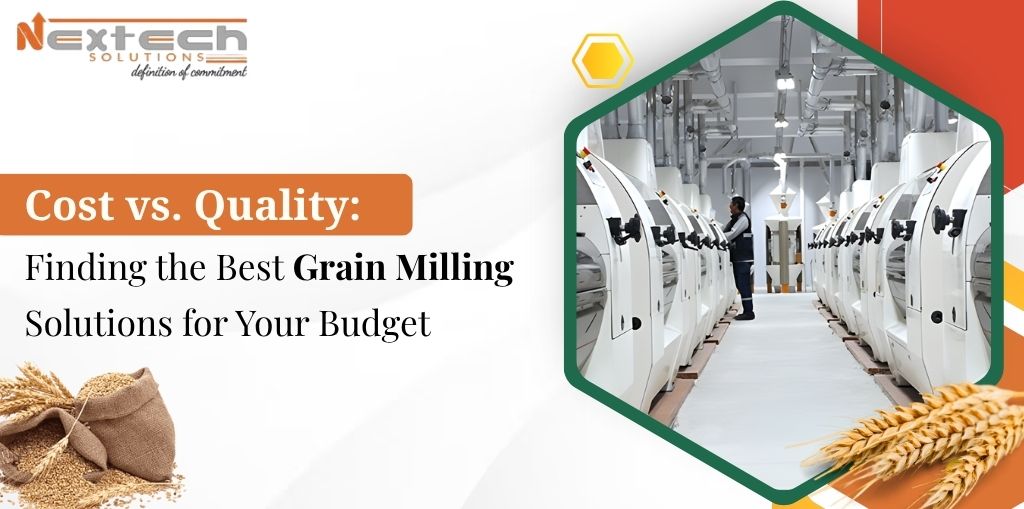
Selecting the right equipment for processing cereals and pulses is one of the most important decisions a mill owner or agribusiness manager can make. With competing priorities — output, yield, longevity, maintenance costs, and product consistency — it’s tempting to chase the cheapest option. But when you factor in downtime, energy consumption, and product waste, cost and quality are inseparable. This guide explains how to balance them and points you toward practical, budget-aware choices in Milling Solutions, with context for businesses working with Nextech Agri Solutions.
Why cost and quality both matter
At first glance, a lower purchase price improves cash flow and reduces initial investment. However, cheaper machines can be less energy-efficient, produce inconsistent particle sizes, require more frequent repairs, and need replacement sooner. These factors raise the real cost per ton of processed grain. High-quality Grain Milling Solutions may cost more upfront but deliver better throughput, lower energy bills, and improved product uniformity — all of which pay back over time.
Evaluate the total cost of ownership (TCO)
When comparing Milling Solutions, go beyond sticker price. Calculate TCO by considering:
- Initial purchase price — obvious, but only one piece of the puzzle.
- Energy consumption — milling is energy-intensive; efficient drives and motors save money.
- Maintenance and spare parts — availability and cost of replacement parts affect ongoing expenses.
- Labor and training — complexity can add staffing costs or training time.
- Downtime risk — robust systems reduce production halts.
- Product yield and quality — better machinery often reduces broken grain and product loss.
A slightly higher upfront cost for well-engineered Grain Milling Solutions often results in a lower TCO when these variables are included.
Match machine capability to production goals
Not every mill needs the same equipment. Define your priorities clearly:
- Are you maximizing throughput or prioritizing fine particle control?
- Is energy efficiency a must because of high electricity prices?
- Do you plan to scale quickly or keep volumes steady?
Choose Milling Solutions tailored to those goals. For example, modular systems let you start with a smaller footprint and add capacity later — useful for growing operations. If product consistency is critical (e.g., for packaged flour), invest in precision grinders and sieving stages.
Look for energy-efficient designs
Energy cost is one of the largest operational expenses. Modern Grain Milling Solutions use improved motor technologies, variable frequency drives (VFDs), and optimized material flow to reduce power draw. Ask suppliers for specific energy consumption figures (kWh per ton) and compare them. Over years of operation, even modest efficiency gains cut costs significantly.
Consider automation and process controls
Automation can reduce labor needs and improve consistency. Simple control systems that monitor temperature, throughput, and motor load help prevent damage and maintain quality. Advanced PLC or SCADA integrations cost more initially but lower error rates and reduce scrap. Evaluate whether automation features fit your skillset and budget — sometimes semi-automated systems are the sweet spot.
Maintenance friendliness and local support
Fast access to service and spares matters. Machines designed for quick access, with standard parts and clear documentation, shorten repair times and reduce downtime costs. If you’re in India or exporting globally, work with providers who offer strong local support networks. Nextech Agri Solutions, for instance, emphasizes after-sales service and readily available spare parts — an important selection criterion for many buyers.
Material of construction and build quality
Stainless steel contact parts, robust bearings, and precision-machined components increase lifespan and maintain hygiene standards for food-grade milling. While these features can add to capital cost, they reduce contamination risks, minimize wear, and lower the frequency of part replacements. Consider where cost savings make sense and where they compromise longevity.
Test runs and references
Before committing, request on-site demonstrations or pilot trials. Seeing Grain Milling Solutions process your specific raw material reveals real-world performance — yield, particle distribution, and energy use. Ask for references from similar customers and visit operating sites when possible. User feedback on reliability and service responsiveness often reveals more than technical brochures.
Financing and lifecycle planning
Financing options can tip the balance toward better-quality equipment. Leasing, EMI plans, or supplier financing enable you to deploy higher-performing Milling Solutions while preserving working capital. Also, plan for lifecycle upgrades: modular designs, retrofit packages, and parts availability extend useful life and protect your investment.
Making the choice: practical checklist
When evaluating offers, use a checklist:
- Does the quoted TCO match my estimates?
- Is energy consumption competitive?
- Are spare parts and service local and prompt?
- Does performance meet my throughput and quality targets?
- Is the machine scalable or modular?
- What warranties and support packages are included?
Conclusion
Choosing the best Grain Milling Solutions means balancing immediate budget constraints against long-term operational realities. A careful TCO assessment, attention to energy efficiency, focus on maintainability, and validation through trials will help you avoid costly regrets. Partner with suppliers who offer transparent performance data and dependable after-sales support — a decision that often proves more valuable than chasing the lowest price. If you’re exploring options, consider how Nextech Agri Solutions’ approach to service and performance could fit your requirements, but always vet technical claims through demonstrations and reference checks before final purchase.