 MAIL US :
 CALL US :
>

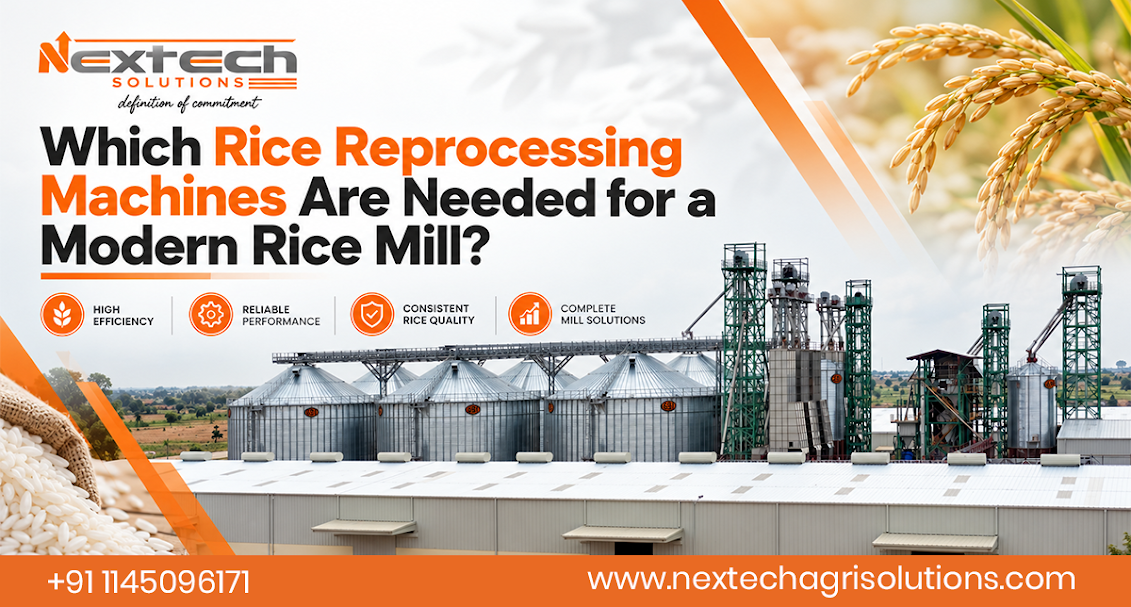
A modern rice mill is judged by the consistency of its final grain. Buyers expect uniform length, bright colour, and a clean finish in every bag. Milling alone rarely delivers this. A second stage of refinement is what gives the grain its market-ready look, and that stage is called Rice Re-Processing. At Nextech Grain Processing & Engineering Solutions Pvt. Ltd., we help mill owners choose the right equipment for this stage so that every batch meets premium standards.
Why Rice Re-Processing Matters in a Rice Mill Business
All rice mill enterprises strive for higher profits on every tonne of paddy. The grain after primary milling has a mix of whole grain, partial grain, and a few of a different color. Rice Re-Processing puts this through other cleaning, grading, polishing and sorting machines, thereby ensuring that every grain is in the category which fetches the highest price.
This is the point where investors in mills tend to make the transition from selling bulk rice to branded and packaged rice. Well-designed re-processing area will ensure that the product will look and cook the same each time, which is a preference of retail chains, exporters and institutional buyers.
The re-processing of rice using Core Machines.
It requires a chain of machines for a complete rice mill plant. They all perform a particular function and work together to create a seamless finishing line.
Destoner and Cleaner Rice
With careful milling, small stones and husk particles and dust can still be present with the rice. A destoner separates heavier particles from the grain by vibrating and air flow, while a cleaner removes lighter impurities. These machines at the beginning of the re-processing line safeguard the subsequent machines and help maintain purity of the grain.
Rice Whitener and Polisher
Polishing has an impact on the smooth surface and attractive appearance of rice. The thin bran layer that still remains is removed by a whitener and then a polisher, typically a water mist or a silky polisher is applied to add the glossy finish that consumers appreciate. Number of passes are chosen to ensure the desired brightness and retain the grain strength at the same time.
Thickness and Length Grader
The rice is graded into size by using a grader machine. Thickness graders are those that employ slotted screens and length graders are those that employ indented cylinders which lift shorter pieces out of the way of long, whole kernels. The machine can combine the production of whole grain, medium head rice and small pieces in the same milling machine, and sell them to their best market.
Colour Sorter
The colour sorter is the essence of any up to date finishing line. It relies on the ability of high-speed cameras and ejectors to discern colour or shape variations in the grains, and ejects them within milliseconds. This provides a uniform, well-radiant look particularly important for export quality basmati and premium non-basmati varieties.
Sifter and Vibro Separator
A sifter can be used to remove small particles and small grain fragments from the main stream. A vibro separator refines this process by sorting gently and continuously by vibrating. The final product is cleaner, and the product quality is consistent from batch to batch.
Mentioning, Storage and Packing Equipment
All machines are linked by bucket elevators, belt conveyors and storage bins to provide a continuous flow of material with little handling. Whole grains are protected during gentle conveying. In the final step, automatic weighing and packing machines ensure accurate filling, ensuring a professional and neat product appearance for your brand.
The Right Rice Mill Layout Plant: plant design is a pivotal stage in the construction of a rice mill.
Machines perform best when they are set up in a well-thought-out configuration. When designing a rice mill layout plant, the following items are taken into account: direction of material flow, distance between machines, elevation of elevators, dust control and space for future expansion. The layout is laid out naturally by the sequence in which the plant is cleaned, polished, graded, sorted and packed and operators work comfortably in the plant with the reduced power usage and floor space consumption.
With good planning, it will also be easy to do daily maintenance. Having access to each machine makes it easy to clean, change the screens and inspect the machines regularly, ensuring the line continues efficiently throughout the shift.
The importance of a rice mill consultant.
There are numerous technical decisions to be made when selecting capacity, machine models and plant design. A knowledgeable rice mill consultant provides hands-on knowledge that enables you to select the right machinery for the right paddy type, market, and price. The consultants will also advise you on power needs, manpower planning and approvals so that your project gets off to a flying start.
Nextech offers end-to-end consultation – from feasibility discussion to commissioning. Our engineers analyse your objectives, draw up a tailored plan and accompany your team and provide support when installing and training. This method is beneficial in helping the new entrepreneur and the established miller to establish a plant that is efficient from the start.
How to Choose Machines for Your Mill
Begin with your market – who will you sell to? Generally, export buyers require high precision sorting and grading processes and local markets may be concerned with polishing and packing. Then determine your hourly capacity and select machines that will support that, and allow for some room for expansion. Last but not least, try to find machinery made of sturdy materials, with readily available spare parts and solid after-sales service. Having these three points will give you the best value from your investment in the long term.
Conclusion
Rice Re-Processing is the process of converting a good milled rice into a high quality product with a brand name. A modern rice mill should be equipped with a destoner, a polisher, a grader, a colour sorter, a sifter and the proper conveying and packing system to make a complete finishing line. By carefully planning your layout and receiving expert advice, your plant can provide a steady output of quality product and yield good profits. Nextech Grain Processing & Engineering Solutions Pvt. Ltd. is here to help you along the way.
Frequently Asked Questions
Rice Re-Processing is?
This is the last step in the milling process, following primary milling, in which the rice is cleaned, polished, graded and sorted for uniformity.
What is the most important machine in a finishing line?
The colour sorter is widely regarded as the most valuable, as it will give a uniform appearance and help to justify high prices.
Can the small rice mill plant be expanded with additional re-processing machines?
Yes. A modular rice mill layout plant allows you to start with the basic machines and expand through graders/sorters as your business expands.
How does a Rice Mill Consultant help?
Your investment will yield reliable results as you’re guided by a consultant in selecting the best machinery, designing your plant, determining the capacity and setting up your project.
Does the re-processing in the rice mill business increase the profits?
Yes. Improved grading and presentation enables the ability to sell each grade at its optimum price, and to enter branded and export markets.